Three U.S. House races from the 2026 election still have no winner: Minnesota's 1st District and Louisiana's 5th and 6th districts. None of them will decide which party controls the House, because Democrats have already passed the 218 seats needed for a majority. But they will set the final size of that majority. They also test how far this year's Democratic gains reached.
Where the three races stand
NBC News uses race calls from the Associated Press (AP). As of Tuesday, its count showed Democrats with 259 House seats and Republicans with 173, according to the YouTube channel The American Ledger, which analyzed the remaining contests. The most recent Democratic pickup came in Tennessee's 4th District. There, a Democrat was officially declared the winner over a Republican congressman who had held the seat since 2011.
Minnesota's 1st District
This district covers the southern part of Minnesota. Republicans held it going into the election. Republican Rep. Brad Finstad faced Democrat Jake Johnson.
On Nov. 19, Minnesota's state canvassing board certified the results. That board is the panel that makes the official count final. Johnson finished 324 votes ahead, or roughly one-tenth of 1% of the vote.
The district shifted sharply this year. Local station KTTC reported that the Democratic margin there moved more than 12 points compared with 2024. Every county in the district moved toward Democrats.
Minnesota does not hold automatic recounts. But when the margin is a quarter of a percent or less, the trailing candidate can request one, and taxpayers cover the cost. Finstad made that request. In Minnesota, a recount means officials review every ballot by hand. Fox 9 reported the process could run from Nov. 30 through Dec. 4.
Louisiana's 5th and 6th districts
Louisiana runs its elections in a way almost no other state does. Candidates from every party appear on one ballot. If no one wins more than half the vote, the top two finishers meet in a runoff, whatever their party.
The state's congressional map also changed in the middle of this election. In April, the U.S. Supreme Court struck down Louisiana's map. Gov. Jeff Landry suspended the May primaries. The legislature then drew a new map and switched House races to the all-candidate system. According to the Louisiana Illuminator, a local news outlet, the 5th and 6th districts were drawn last spring to favor Republican candidates.
Both runoffs are on Saturday, Dec. 12. In each district, a Democrat placed first in the opening round:
5th District (northeast Louisiana): State Rep. Pat Moore, a Democrat from Monroe, received about 18% in a field of nine. State Rep. Gabe Firment, a Republican from Pollock, received about 17%.
6th District: Former Baton Rouge Metro Council member Shauna Banks, a Democrat, and state Sen. Blake Miguez, a Republican from New Iberia, each received about 19% in a field of 10. A little more than 600 votes separated them.
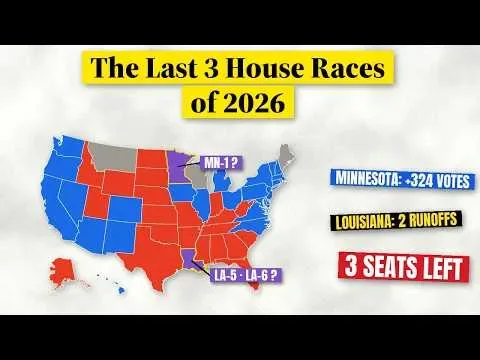
Photo: YouTube / The American Ledger
Why the early numbers can mislead
In two of these races, The American Ledger argues that the first-round results paint a rosier picture for Democrats than the full numbers support. In the third, the question is whether a recount can overturn a certified lead.
The Louisiana math
The key is how the vote was divided. In the 5th District, six of the nine candidates were Republicans. Together they won 62% of the vote, according to the Illuminator. The three Democrats shared the remaining 38% or so. Moore finished first because the Republican vote was split among more candidates. In a one-on-one runoff, that split disappears.
By the channel's own math, if the same voters return, Moore would need to rise from about 38% to 50%. That means winning roughly 12 points from people who backed a Republican in the first round. Put another way, about one in five of those voters would have to switch to her or stay home while Democrats keep turning out.
The gap in the 6th District is smaller. The Illuminator reports that six Republicans together won 57%. Three Democrats and a Libertarian together won about 43%. The channel calculates that even if Banks won every one of those other voters, she would still need about seven more points. That works out to roughly one in eight Republican first-round voters switching or staying home.
The Minnesota math
To judge whether a hand recount could erase 324 votes, the channel points to a study by FairVote, an election reform group. FairVote examined more than 7,400 statewide general elections from 2000 to 2025. Only 37 went to a full statewide recount. Only three of those changed the winner, and each began with an extremely narrow margin. According to the channel's summary of the study, recounts moved the margin by about 550 votes on average across an entire state, and the leader's lead usually grew.
One of those three reversals happened in Minnesota. In the 2008 U.S. Senate race, Republican Norm Coleman began the hand recount 215 votes ahead. Democrat Al Franken finished 225 votes ahead. That was a swing of 440 votes across the whole state. Finstad would need to gain more than 324 votes within a single congressional district, a much smaller area.
What each side is saying
In Minnesota
Johnson's campaign said history shows the recount will not change the outcome. The source material does not include a statement from Finstad explaining his request, so his reasoning is unclear.
In Louisiana
Both Democratic candidates hold conservative positions on some social issues. The Illuminator reports that Moore opposes abortion and has voted for several conservative social measures. The state Democratic Party withdrew its endorsement of her in September over those views. It backed her again only after she made the runoff. Explaining her party choice, Moore said: "The reason I'm a Democrat is because this is a party that's inclusive, even if we don't agree."
Banks told the Illuminator she believes life begins at conception. The channel suggests these records could help both candidates reach Republican-leaning voters.
Money is another factor. Before the first round, the Democrats had raised very little, according to the Illuminator. As of Oct. 15, Banks had not raised or spent more than $5,000. Moore had raised about $23,000. Miguez had raised $7.7 million, the most in the field, including $3.5 million he loaned his own campaign. Firment had raised about $454,000.
That has shifted. Moore's campaign says it has raised at least $1 million since Election Day, in about a week. Banks says her campaign is getting calls from across the country. With few other races left, national donors have turned to Louisiana. The Republican campaigns say their fundraising is up, too.
Democrats point to the state's U.S. Senate race as a hopeful sign. The Republican won by less than two points statewide, 50.9% to 49.1%, over Democrat Jaime Davis, according to NBC. Louisiana has voted for President Trump three times by wide margins. Rep. Troy Carter, a Louisiana Democrat, told the outlet Midas Touch he expects some Republicans to stay home, some to cross over and Democratic turnout to remain high.
The case for Republicans rests on the map. A Republican legislature drew these districts to elect Republicans. The channel notes that the combined first-round results, 62% and 57% Republican, suggest that design held up in a strong Democratic year. December runoffs also usually draw far fewer voters than November elections, which makes them harder to predict.
Both Republican candidates have already visited Washington. According to Baton Rouge station WVLA, Miguez and Firment attended orientation for new members of Congress and appeared in the freshman class photo. Moore's campaign accused Firment of celebrating too early. Both Republican campaigns said all runoff candidates were invited and that they attended to be prepared. Banks said she was invited but stayed home to campaign. "I was taught a long time ago not to put the cart before the horse," she said.
What happens next
The American Ledger offered its own ratings, which it stressed are not an official forecast. In race ratings, "likely" signals a clearer edge than "lean."
Minnesota's 1st: Likely Democrat. The channel calls the recount a safety check rather than a second election.
Louisiana's 6th: Lean Republican. The channel sees this as the race most likely to surprise people.
Louisiana's 5th: Likely Republican.
If those ratings hold, Democrats would finish with 260 seats and Republicans with 175. If Democrats win all three, they would reach 262. If Republicans win all three, the final count would be 259 Democrats and 176 Republicans.
Key dates to watch:
Nov. 30 to Dec. 4: Minnesota's hand recount, according to Fox 9.
Nov. 30: Louisiana candidates file new fundraising reports, which will show whether the reported surge in donations is real.
Before Dec. 12: Early voting in Louisiana. The channel says strong Democratic turnout in Baton Rouge and Monroe would make both races more competitive.
Dec. 12: The Louisiana runoffs, the last House races of 2026.
Once those results are in, the House map for the next Congress will be complete.
3 of 37
Of the 37 full statewide recounts FairVote found from 2000 to 2025, only three changed the winner.
P.S. Counting every ballot by hand takes patience. We'll bring you the final House tally once the last votes are in.